Radiator Repair: What It Costs and How to Fix a Radiator the Right Way
If your temperature gauge is climbing, you're seeing a puddle under the vehicle, or the heater blows cold, the radiator repair answer depends on what's actually failing. A cooling system moves coolant through the engine and back out to the radiator, where heat is released into passing air. When a radiator hose splits, a seam cracks, or the water pump wears out, the engine can overheat fast, and driving on it turns a small repair into a major one.
At Three Brothers Auto Repair, 370 Paterson Ave in East Rutherford, every radiator repair starts with a pressure-test diagnostic so you get a firm number before any work begins, not a guess that grows on the invoice. We're open Monday through Saturday, 8:00 to 6:00, and our ASE-certified technicians back every job with a 12-month/12,000-mile warranty.
Below: what a repair actually costs in NJ, the warning signs to watch for, our step-by-step process, and when a radiator can be soldered or patched versus when it needs a full radiator replacement.
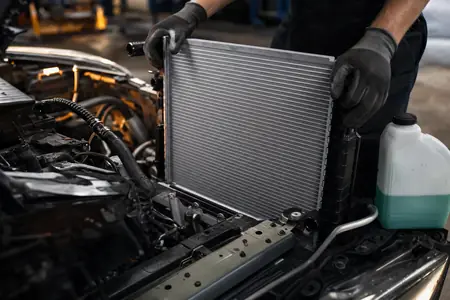
How Much Does Car Radiator Repair Cost?
Every radiator repair starts with a pressure-test diagnostic, so you approve a firm number before we touch the vehicle.
| Repair / Service | Cost (NJ) |
|---|---|
| Cooling system diagnostic | $120–$180 |
| Minor radiator leak repair or sealant service | $100–$300 |
| Radiator core or tank repair | $300–$600 |
| Radiator replacement (parts + labor) | $500–$1,200 |
| Labor only (you supply the radiator) | $200–$400 |
| Hoses, clamps & coolant | $120–$240 |
Harder-to-reach radiators, corroded hardware, and specialty coolant formulas push a job toward the higher end; a leak caught early stays near the lower end. Full breakdown on the NJ radiator repair price guide and our prices page.
Start here. Cooling system diagnostic: pressure test, hose, radiator cap, thermostat, and water pump check. Credited toward the repair if you move forward with us. Same-day service on most cooling system jobs, 370 Paterson Ave, East Rutherford. Mon–Sat 8:00 AM–6:00 PM. Call 201-935-5100 or book an appointment.
Call 201-935-5100 Book an appointment370 Paterson Ave, East Rutherford · Mon–Sat 8:00 AM–6:00 PM
How a Radiator Keeps Your Engine Cool
A car radiator pulls heat out of the coolant leaving the engine and releases it into passing air, holding engine temperature in a safe range. Coolant, antifreeze mixed with water, circulates through thin metal tubes and fins as part of internal combustion engine cooling, while the radiator cap keeps the system pressurized so coolant flow stays steady under load. Most radiators today use aluminium cores, though older vehicles still run copper-and-brass units.
Most radiator problems trace back to a few points: metal fatigue and heat cycling that crack a tank, a worn cap that loses pressure, a split hose that drains the coolant level, and internal debris — rust, scale, old antifreeze — that clogs the tubes and cripples the radiator's ability to shed heat. Any of these reduces the cooling system's efficiency and fuel efficiency, and left alone, leads to an overheating engine and significant damage to the head gasket or cylinder heads.
Radiator Problems and Warning Signs That Need Immediate Attention
We've diagnosed hundreds of cooling system failures. These are the signals we see most often.
A rising temperature gauge, especially in stop-and-go traffic, means the system can't shed heat fast enough.
Greenish or orange fluid under the car means you're leaking coolant, not seeing condensation. Inspect it before driving further.
Topping off every few days usually means you're low on coolant somewhere, and it's going in or out for a reason. Low coolant levels stress the whole cooling system.
Corrosion on the fins or sludge in the reservoir signals the radiator and flush is overdue.
Boiling coolant escaping the system means stop driving and call us before heat buildup causes further damage.
A few drops this week becomes a steady drip next month. Small leaks never shrink on their own.
From our shop: a customer once ignored a minor coolant drip for three weeks. By the time the vehicle reached us, the cylinder heads had warped, turning a $400 radiator repair into a $4,200 engine rebuild. Catching a leak early is the whole game.
Our 6-Step Process to Repair a Radiator
No parts-swapping and hoping for the best. Every vehicle goes through the same sequence.
A pressure tester checks the core, hose, radiator cap, thermostat, and water pump.
We pressurize to manufacturer spec to expose hidden cracks and weak seams before we diagnose radiator damage further.
Minor leaks we fix; severe corrosion gets an OEM-quality radiator replacement, with the reasoning explained.
Contaminated fluid out, your manufacturer's specified coolant in, restoring proper coolant flow.
Radiator failure often starts with a cheap hose, so anything cracked or rusted gets replaced now.
After bleeding air pockets, we monitor engine temperature under real load to confirm the fix holds.
Radiator Repair and Replacement Services: Solder, Weld, Epoxy
Not every radiator needs replacing. Once we diagnose radiator damage on the pressure tester, we match the method to the material and the damage.
Sealant or patch
For a pinhole leak in an otherwise sound radiator, a proper cooling-system sealant restores reliable function.
Solder repair
Older copper-and-brass radiators can be cleaned and soldered at the seam, durable while the metal is still solid.
Weld or epoxy
Modern aluminium cores don't take solder well, so a cracked tank is welded or sealed with a coolant-rated, high-temperature epoxy.
Full replacement
With multiple cracks, heavy corrosion, or a collapsed core, we replace the radiator with an OEM-quality unit that outlasts any patch.
DIY radiator epoxy and stop-leak products have their place in a limp-home emergency, but a driveway fix rarely survives real pressure and repeated heat cycling. We'll tell you honestly when a lasting fix is possible and when replacement is the smarter spend.
Why Choose Three Brothers Auto Repair
Three Brothers Auto Repair is a family-run auto repair shop at 370 Paterson Ave in East Rutherford, staffed by ASE-certified technicians with decades of hands-on automotive service experience. Drivers from East Rutherford, Rutherford, Carlstadt, Lyndhurst, and the rest of Bergen County bring us everything from a slow coolant leak to a full radiator replacement, and every job gets the same pressure-test diagnostic before any work begins.
Founded by the Henderson family, the shop runs on a simple rule: explain the problem, quote it honestly, and stand behind the fix. That's why every repair carries our 12-month/12,000-mile warranty, whether it's a solder job on an old copper core or a same-day radiator swap.
- Temperature gauge — If it's climbing above normal, pull over and let the engine cool before continuing.
- Coolant level — Check the reservoir when the engine is cold. Low coolant levels point to a leak somewhere in the system.
- Ground beneath the car — A puddle of greenish or orange fluid means it's time for a diagnostic, not a guess.
- Accessibility of the repair — Some radiators sit in tight engine bays, which affects labor time and final cost.
Ready for a firm number instead of a guess? Call 201-935-5100 or use the price guide and prices page linked above to see where your repair likely falls, then book an appointment at 370 Paterson Ave, East Rutherford, Monday through Saturday, 8:00 to 6:00.